|
Page 2 of 3

Robert Melcanton Metcalfe
born 1946, Brooklyn, New York
The next stage of the story is more refinement of the basic idea. Enter Robert Metcalfe, an early Internet enthusiast. He knew about ALOHAnet and started to think about the problem of connecting computers together.
With the primitive Internet only connecting a small number of computers it was reasonable to run a cable between each pair of machines but when the Internet started to grow this quickly became ridiculously expensive. Without a workable alternative, the Internet as we know it today wouldn't and couldn't exist.
Metcalfe started to think about how a single wire connecting a number of machines could be shared. The clever idea he had was to extend the ALOHAnet idea of
transmit, listen, back-off
to
listen, transmit, listen and back-off.
Classic cocktail party strategy if every I heard it!
What do you do when you are in a group of people talking?
If you are socially well adapted then you wait until there is a silence and when you start speaking you monitor the situation to see if you are talking at the same time as another person. If you are then you stop, back off and wait for the silence to return.
If this all sounds familiar then you have more or less invented the principles behind Ethernet.
Take a single cable. Originally this was a very thick armoured coaxial cable that was threaded through a building. Connect computers via “tap” connections which give all of them equal access to the transmission medium. Any machine connected to the cable can transmit data and receive data but if more than one machine tries to transmit the result is a collision and nothing gets through. What Metcalfe invented was essentially the “party etiquette” algorithm.
Each Ethernet interface contained the electronics necessary to listen for a quiet time on the cable – this is called “carrier sense”.
If it finds one it can start transmitting a packet, a short burst of data. Packets are of a variable size but a multiple of a basic time slot. If a collision is detected then all parties to the collision wait for a random time that is a multiple of the time slot and then try again.
If they detect a second collision they back off for a random time that is on average twice as long and so on each time a collision is detected.
This is called “exponential back off”. As long as the cable isn’t too heavily loaded the protocol works to get most of the data through when it is needed.
The Ethernet protocol is usually referred to as CSMA/CD or “Carrier Sense Multiple Access/Collision Detect” and you should now be able to understand the origin of each of these terms.
Implementing Ethernet
Metcalfe and David Boggs, his assistant, published a paper in 1976 describing Ethernet but it developed over a number of years.
The first two computers they connected together, at the now famous Xerox Parc laboratory, were called Michelson and Morley after the two physicists that performed an experiment to measure the speed of light through the “luminiferous aether”. Their experiment proved that the “aether” didn’t exist but what else could you call a communication channel that connected Michelson and Morely but “Ethernet”?
Metcalfe left Xerox in 1979 to promote the use of Ethernet as an industry wide standard and to form 3Com, a company making Ethernet hardware. It didn’t take off overnight. For one thing the hardware was expensive. For another there were alternatives such as token ring networks, pioneered by Cambridge University and taken up by IBM as a commercial product.
In the early days network hardware was as big as a microcomputer, or rather a small minicomputer, and it took many years before it was made small enough and cheap enough to make it worthwhile to connect microcomputers together.
Three big companies Digital, Intel and Xerox got together to produce the first standard for Ethernet – sometimes called DIX Ethernet. Today the standards are set by the IEEE and the number that you will hear most often is 802.3 which refers to a set of modern Ethernet standards.
The standardisation of the hardware protocols made it possible for a range of manufacturers to enter the market making compatible electronics – or NICs, Network Interface Cards.
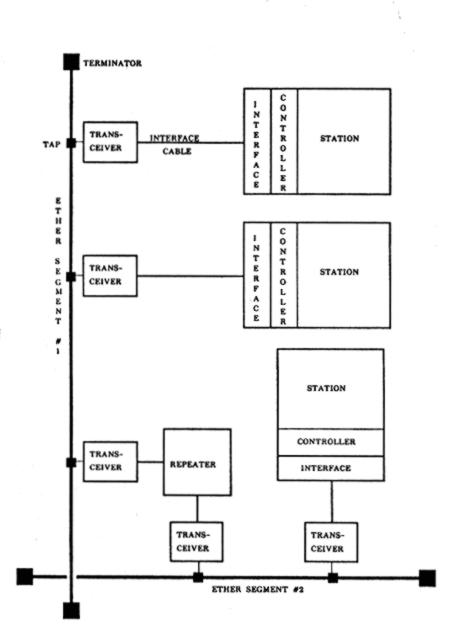
A later sketch of a two segment network
An equally big problem as the hardware was the software. There just weren’t any network-based operating systems at the time. Eventually a small company called Novell introduced a network-based operating system that solved the software problem for a while, but that’s another story!
It took quite some time for lower-cost, peer-to-peer networking operating systems to appear and initially there were a range of non-standard extensions to MS-DOS and then Windows before Microsoft woke up and produced Windows for Workgroups – which more or less standardised the software until the Internet appeared on the scene.
Back in the early days, if you wanted to install Ethernet local area networking then you had a very thick coaxial cable installed though the building. This was armoured and difficult to install. If a new computer was to be connected you first had to find the backbone cable and drill into it with a special tool. This removed the armour and allowed you to clamp onto it a box called a "tap" which had a spike that pierced the cable until it hit the central conductor. The tap then fed the signal to a fairly large piece of electronics which then connected to the computer that wanted to join the network. In the early days you could occasionally see a tiny micro computer hooked up to the Ethernet via a computer that was bigger and more powerful than it was.
Clearly things had to get cheaper and simpler before Ethernet could be the commonly used communications system it is today.
|