| New 'Swarm' Computing Center |
| Written by Sue Gee | |||
| Sunday, 27 January 2013 | |||
|
TheTerraSwarm Research Center has been set up to address the huge potential (and associated risks) of pervasive integration of smart, networked sensors and actuators into our connected world. Based at the SwarmLab at the University of California, Berkeley, the nine-university project has received a $27.5 million, five-year grant from DARPA (Defense Advanced Research Projects Agency) and the Semiconductor Research Corporation and DARPA as a part of the STARnet (Semiconductor Technology Advanced Research Network). It is an interdisciplinary collaboration which will study the potential applications and risks of “swarm-based” computing.
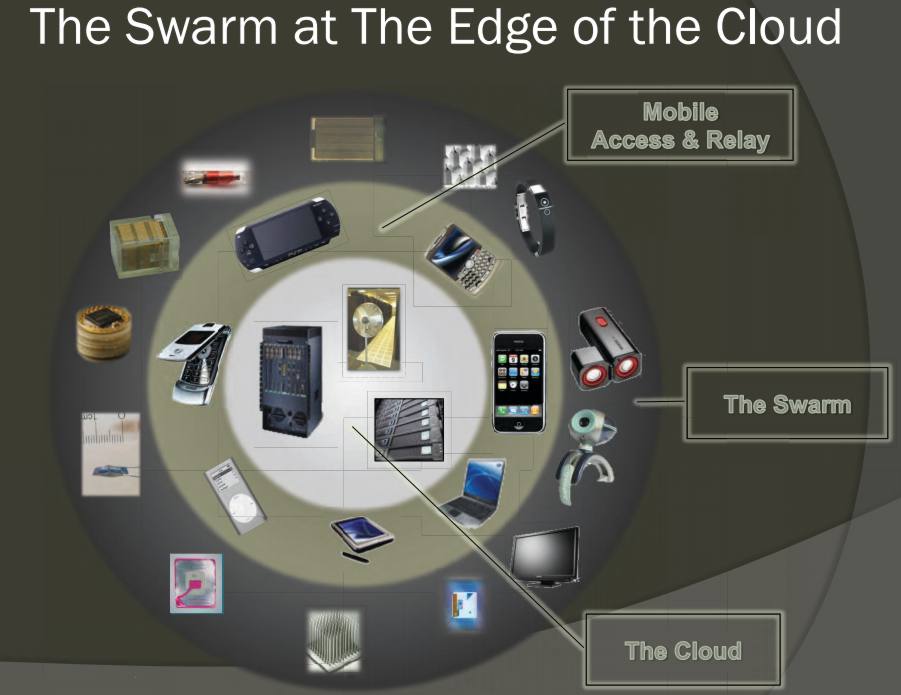
Source: SwarmLab Seminar Nov.1, 2012 The description of TerraSwarm Center on the STARnet site states: The TerraSwarm Research Center (TerraSwarm) aims to enable the simple, reliable, and secure deployment of a multiplicity of advanced distributed sensecontrol-actuate applications on shared, massively distributed, heterogeneous, and mostly uncoordinated swarm platforms through an open and universal systems architecture. The University of Pennsylvania is one of the institutions contributing to the TerraSwarm Center and the announcement in Penn News clarifies: For TerraSwarm Center “the swarm” is an extension of “the cloud” that goes well beyond information technology to improve energy efficiency, safety, comfort, security and human effectiveness by integrating the physical world with the cyber world. It leverages recent advances in the variety, cost, size and power consumption of sensing and actuation devices and the associated communication networks. Sensors on these devices can collect a range of data — including video, audio, location, movement, temperature and air quality — that can be used by computing systems to direct physical devices in smart buildings, transportation systems, medical systems, security systems and homes. A key goal of the TerraSwarm Research Center is to enable swarms to be deployed at a much larger scale, extending across a city and beyond, and to interact synergistically with each other, with pervasive networked handheld devices and with the computing "cloud." Swarm data can then be combined with information already available from cell phones and social-networking applications, dramatically increasing the potential for sophisticated data analysis and correlation.
TerraSwarm has attracted a team of twenty researchers from UC Berkeley, Penn and seven other universities plus another two investigators from Intel Lab and holds its inaugural meeting on January 29, 2013.
More Information
Related ArticlesData Analytics for Weathering Storms
To be informed about new articles on I Programmer, install the I Programmer Toolbar, subscribe to the RSS feed, follow us on, Twitter, Facebook, Google+ or Linkedin, or sign up for our weekly newsletter.
Comments
or email your comment to: comments@i-programmer.info
|
|||
| Last Updated ( Sunday, 27 January 2013 ) |