| Q.bo and the Xtion Pro Live 3D sensor |
| Written by Lucy Black | |||
| Tuesday, 27 March 2012 | |||
|
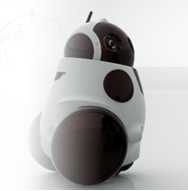
The Q.bo robot has been experimenting with using the Xtion Pro to provide it with 3D vision. The team at TheCorpora Robotic Company has added an ASUS's Xtion Pro Live sensor to the existing set of sensors for Q.bo, its cute soon-to-be-released robot. Q.bo already has two HD webcams and can be fitted with 4 ultrasound sensors (2 in the front, and 2 in the rear), but in an attempt to give it a 3D sensing capability, the team crafted an adapter for the small. lightweight ASUS sensor in a mount that fits over Q.bo's head.
The blog post announcing this innovation explains: The ability of autonomous localization and simultaneous mapping are crucial for autonomous robots who need to adapt to their environments. In Robotics, this method is known as SLAM (Simultaneous Localization And Mapping) and it can be implemented in several algorithms relevant to 2D or 3D environments by using different types of input sensors (laser, sonars, odometry, webcams, etc.).
[The ASUS] sensor emits a 3D point cloud that, along with the robot’s odometry sensor and the incorporated gyroscope, enables Q.bo to build maps, 3D modeling of objects and autonomous localization in real-time. This system can be seen as a more accurate and sophisticated visual perception compared to the stereoscopic cameras or the ultrasound sensors. However, the joint use of all systems (ultrasounds, webcams and Xtion) can generate a much more complete information than the separate use of each.
This 5-minute video shows the Xtion Pro Live sensor being mounted over a prototype mold designed by Thecorpora’s team and then it shows three experiments using Q.bo and the Xtion Pro live sensor:
More InformationRelated Articles
Comments
or email your comment to: comments@i-programmer.info
To be informed about new articles on I Programmer, subscribe to the RSS feed, follow us on Google+, Twitter, Linkedin or Facebook or sign up for our weekly newsletter.

|
|||
| Last Updated ( Saturday, 24 June 2017 ) |