| Kinect for Windows 1.5 Announced |
| Written by Kay Ewbank | |||
| Thursday, 29 March 2012 | |||
|
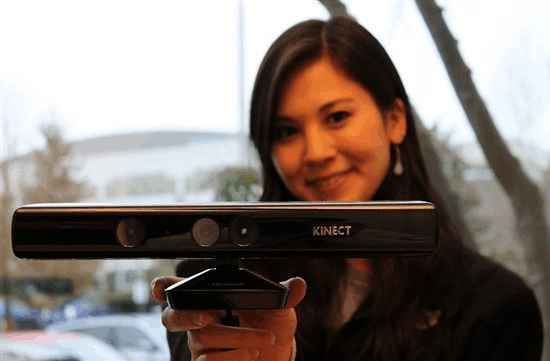
Version 1.5 of the Kinect for Windows SDK will be available at the end of May, together with Kinect Studio, an app that lets developers record, play back and debug recordings of users engaging with their apps. The new release will also add “seated” or “10-joint” skeletal tracking, which provides the capability to track the head, neck and arms of either a seated or standing user. This opens up new possible applications where users sit in front of their PC and control an application. The improved close distance range of the version 1 Windows Kinect also helps implement "seated" apps.
Although much of the "exciting" applications of the Kinect focus on the depth camera its speech recognition and general audio abilities are predicted to have just as much an effect once programmers manage to appreciate their potential. Four new languages are being added for speech recognition – French, Spanish, Italian, and Japanese, and Microsoft is also releasing new language packs to overcome the limitations of speech recognition for existing languages. New packs will enable speech recognition for the way a language is spoken in different regions: English/Great Britain, English/Ireland, English/Australia, English/New Zealand, English/Canada, French/France, French/Canada, Spanish/Spain and Spanish/Mexico. The initial release of Kinect for Windows was made in February and works with Windows 7 PCs. In a blog post about the new version, Craig Eisler, General Manager Kinect for Windows, said that Microsoft will be launching Kinect for Windows in nineteen more countries in the coming months. “We will have availability in Hong Kong, South Korea, and Taiwan in late May. In June, Kinect for Windows will be available in Austria, Belgium, Brazil, Denmark, Finland, India, the Netherlands, Norway, Portugal, Russia, Saudi Arabia, Singapore, South Africa, Sweden, Switzerland and the United Arab Emirates.” More InformationKinect Blog - What’s Ahead: A Sneak Peek Further ReadingTo start programming with the Kinect seePractical Kinect for Windows in C# Avatar Kinect - a holodeck replacement A Kinect Princess Leia hologram in realtime Kinect augmented reality x-ray (video) Kinect plus a glass wedge gives ... Kinect goes self aware - a warning Kinect knows what you are doing...
Comments
or email your comment to: comments@i-programmer.info
To be informed about new articles on I Programmer, subscribe to the RSS feed, follow us on Google+, Twitter, Linkedin or Facebook or sign up for our weekly newsletter. 
<ASIN:B006UIS53K@COM> <ASIN:B0078LMS72@UK> <ASIN:B002BSA298@COM> <ASIN:B0036DDW2G@UK> <ASIN:B0036DDW2G@FR> <ASIN:B002BSA298@CA> <ASIN:B003H4QT7Y@DE> <ASIN:B00499DBCW@IT> |
|||
| Last Updated ( Thursday, 29 March 2012 ) |