| On This Day in 1946 - Eniac Unveiled |
| Monday, 14 February 2011 | |||
|
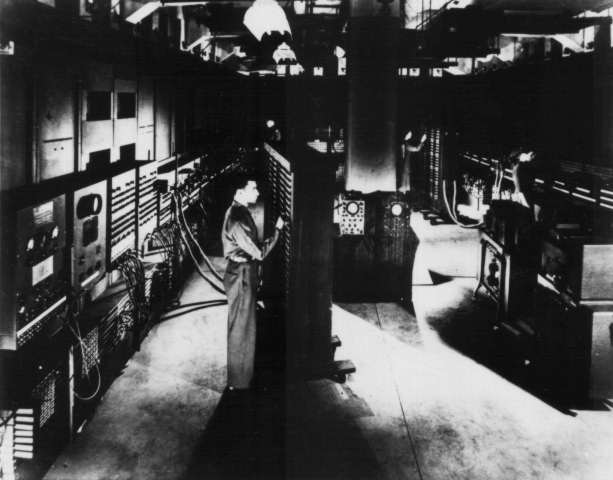
On February 14, 1946 at the Moore School of Electrical Engineering, University of Pennsylvania. John Mauchly and J. Presper Eckert unveiled ENIAC, the computer they had started to build in 1943. ENIAC was a huge machine and calculated 5,000 operations per second - 1,000 times faster than its contemporaries. Mauchly and Eckert had started to build their Electronic Numerical Integrator and Calculator, to use its full name, in 1943 with the innovative idea of using valves. The result was a huge machine. It occupied over 1,500 square feet of space and weighed 30 tons. It.used just short of 18000 valves arranged in racks 100 feet long in total. It consumed enough electricity for a small town and disposing of the heat produced by the valves was no small problem. But its claim to fame at the time was its speed of calculation. It could add two numbers in 0.2 milliseconds, or to put it another way performed 5,000 operations per second - 1,000 times faster than its contemporaries. ENIAC was used for 10 years and did a huge amount of computation in that time. It not only computed trajectories but ran the simulations needed for the H bomb. It also caught the public imagination. In a public demonstration it took only twenty seconds to work out the trajectory of a shell that took 30 seconds to reach its target. ENIAC's flashing lights and switch banks also set the look of machines in film and fiction that has hardly changed through to the present day!
ENIAC (U. S. Army Photo) Only six weeks later Mauchly and Eckert were to leave the University of Pennsylvania because they refused to sign over their patent rights as demanded by the university. As a result the Moore School lost the lead in computing and the first ever computer company - The Electronic Control Company - came into existence. For the full story see the article in our History section:

|
|||
| Last Updated ( Saturday, 08 June 2019 ) |