| A Pico For the Holidays |
| Written by Harry Fairhead |
| Sunday, 07 December 2025 |
|
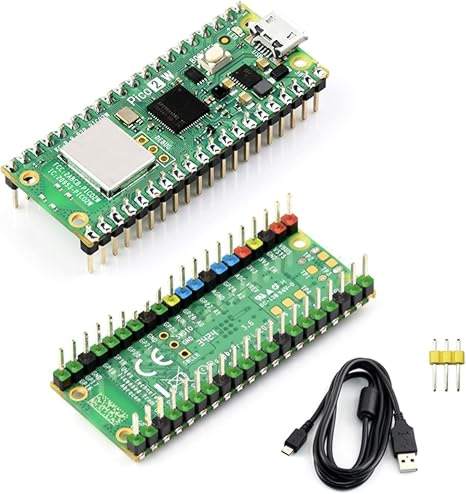
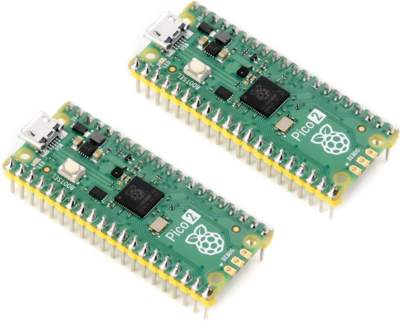
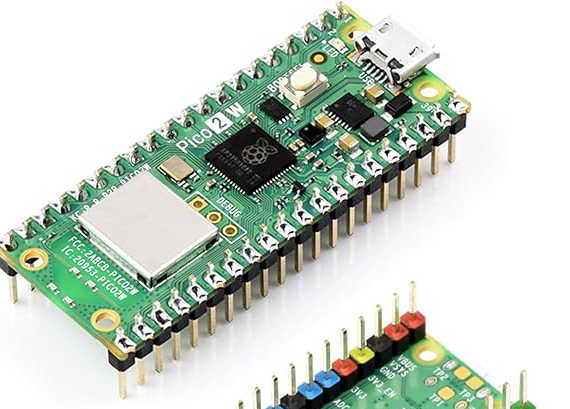
The holiday season is a good time to acquire a new skill - you have the time and don't want to go outdoors. How about getting into electronics and home automation? My recommendation for this is the Raspberry Pi Pico, specifically the Pico 2W, where W indicates in-built WiFi. Disclosure: If you make a purchase at Amazon by clicking on the product images in this article we may earn an affiliate commission. While its name may make the Pico sound like a cut-down member of the Raspberry Pi family, that isn't a fair representation as for physical computing it is in many ways superior, in particular by being faster and more powerful, and it is certainly easier from the point of view of understanding what is happening. It doesn't run Linux, or any operating system, and you can program it using a high-level language - with MicroPython and C being the top choices. Originally launched in 2021 it is now in its second generation and there are two variants, the Pico 2 and the Pico 2W, which supports WiFi and Bluetooth and is therefore ideal in situations where you want to share data to a remote computer. If you want to know about the two models see Pico 2 Faster With More Memory And RISCier and Pico 2W Announced But There Is A Surprise! After a recent price hike the Pico 2 (left) costs around $10 and the Pico 2W (right) around $12. Buying a device with a Header saves on soldering.
Click in image for Amazon details Now for some inspration and learning all the basics of IoT programming. This is where my books in the I Programmer Library come in.
Click in image for Amazon details The purpose of the introductory Programming the Raspberry Pi Pico/W in C and Programming the Raspberry Pi Pico/W in MicroPython is to reveal what you can do with the Pico's GPIO lines together with widely used sensors, servos, motors and ADCs. After covering the GPIO, outputs and inputs, events and interrupts, it gives you hands-on experience of PWM, the SPI bus, the I2C bus and the 1-Wire bus. One of the key advantages of the Pico is its PIO (Programmable I/O) and, while this is an advanced feature, it is introduced in this book. The PIO isn’t the solution to every problem, but it is very useful, challenging and a lot of fun. The C version of the book also introduces FreeRTOS, a realtime operating system that lets you utilize both cores of the the Pico2.
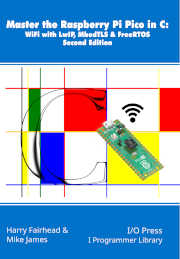
Once you are ready to go further with the Pico 2W using FreeRTOS then the book you need is Master the Raspberry Pi Pico in C, 2nd Ed which is a highly practical introduction to the two libraries that support WiFi: the Lightweight Internet Protocol (lwIP) and Mbed Transport Layer Security (mbedTLS). Modern communication is almost always encrypted and this can prove difficult for IoT devices with limited power and memory. Accordingly the book take a hands-on look at practical cryptography. As well as implement an HTTPS client using the standard certificate bundle and then a corresponding server which is a matter of supporting the appropriate encryption suites and certificates, it also has chapters covering UDP, SNTP, SMTP and MQTT in turn. The final chapters use FreeRTOS and sockets to implement HTTP and HTTPS clients and servers including an initialization server which lets the user configure an IoT device. Source code is available for all the projects.
Related ArticlesMaster the Raspberry Pi Pico in C 2nd Ed (I/O Press)
|
| Last Updated ( Sunday, 07 December 2025 ) |