| A Kinect Musical Sculpture |
| Written by David Conrad | |||
| Saturday, 07 April 2012 | |||
|
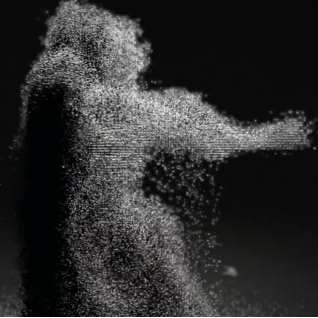
Take three Kinects, a dancer and a 3D physics engine and what you have is, without question, an art form. Is it modern ballet, kinetic art or perhaps Kinect art? It's an amazing creation that you have to see. One of the limitations of using a single Kinect is that you only get a depth field for the front view of an object. Add another Kinect and you get front and side. If you use three, arranged in a triangle, the result, for a large area in the middle, is a complete 3D point cloud of the object. This simple observation is the reason that so many multi-Kinect installations are starting to appear. However what do you do with this data?
For digital artists Daniel Franke and Cedric Kiefer the answer is you get a dancer, Laura Keil, to improvise. Take the video and convert it to 22,000 3D points as a solid model, add a little simulated gravity, and you have something that looks as if the dancer was made of powder. The time lag of the decaying particle field makes the dancer's movements blend together as if time were smeared out. But why not simply watch the video rather than read a poor description:
You can see the details of how the whole effect was achieved in the following video which also shows a number of alternative renderings. In many ways, this is the more fascinating of the two videos because it opens your eyes to the possibilities of the technology:
So where next?
More InformationIf you would like to see the videos in higher definition then click: daniel-franke.com/unnamed_soundsculpture.mov Related ArticlesShake n Sense Makes Kinects Work Together!
Comments
or email your comment to: comments@i-programmer.info
To be informed about new articles on I Programmer, subscribe to the RSS feed, follow us on Google+, Twitter, Linkedin or Facebook or sign up for our weekly newsletter. 
|
|||
| Last Updated ( Saturday, 07 April 2012 ) |