| Citation map shows top science cities |
| Written by Mike James | |||
| Sunday, 20 March 2011 | |||
|
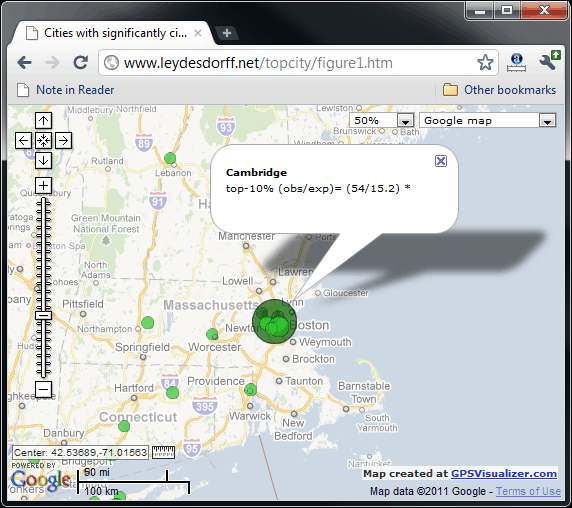
Which cities around the world produce not just the most but the best scientific papers? Using a database and Google Maps the answer is obvious. One of the exciting things about the web is the way that it brings data from different sources together - a little clever processing and you can reveal something that was previously difficult to see. A paper in Physics arXiv describes how two researchers combined citation data with Google maps to create a plot showing how important cities around the world were in terms of their contribution to physics, chemistry or psychology. The idea is simple enough - scientific papers cite other scientific papers and it is usually held that the more a paper is cited the more important it is. So taking the data from the Web-of-Science database the researchers simply counted how many papers originated from each city and plotted a circle with a radius proportional to the number of papers on Google Maps. They then looked at the number of papers that you would expect to be in the top 10% most cited papers from each city, i.e. 10% of the papers compared to the number that were actually in the top 10%. The difference indicates how successful the city is in producing important papers and not just their volume. They plotted the circles in red for lower performing cities and green for higher performing cities. So a small green circle indicates a small high quality output and a big red circle indicates a high volume but lower quality output.
Inspecting the maps raises questions on several levels such as how language affects citations and the effects of isolated communities of researchers who cite each other's work but do not make references outside of their circle. Even so it is an interesting study. You can read the complete paper at. MapsPhysics: http://www.leydesdorff.net/topcity/figure1.htm Chemistry: http://www.leydesdorff.net/topcity/figure2.htm Psychology: http://www.leydesdorff.net/topcity/figure3.htm

|
|||
| Last Updated ( Monday, 24 September 2018 ) |