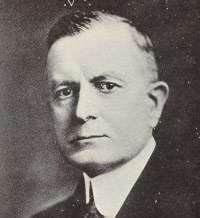
| Father of IBM Born On This Day In 1874 |
| Written by Historian | |||
| Sunday, 17 February 2013 | |||
|
Thomas J Watson, the man who gave IBM its name in the era when it made punch card machines and was responsible for its distinctive management style and corporate culture, was born on February 17, 1874. It is easy to characterize IBM as a huge monolith of a company that has always been there, probably never deserved to be there and is certainly no good thing. The same sort of attitude extends to its founder - Thomas J Watson. He is often stereotyped as the super salesman, interested in nothing but sales and totally uninterested in products. If you follow this view you can be led to believe that IBM was drawn into computing by accident and, that Watson resisted the move, and only made a success of it all by being good at selling. However the real story is rather more interesting..
Thomas J Watson By the mid-twentieth century Watson would have counted as one of the world's richest men but his fortune was entirely self made. He had been born in New York State into a family of Scottish decent who had emigrated from Ireland to avoid the potato famine. His father farmed and was involved in the lumber business. Having quit a teaching job after a single day Watson decided to go into business - but he had a decidedly checkered career selling sewing machines. He did well as a manager for NCR (national Cash Registers) but was fired when he argued with the boss of the company. He next took up the challenge, in 1914, of managing the Computing-Tabulating-Recording company (CTR). Formed out of Herman Hollerith's Tabulating Machine company which produced the machines famously used in the 1890 census. By the time Watson joined it, the firm it was deep in debt. One of Watson's first moves was to improve the tabulating machine that Hollerith had invented by examining, and reverse engineering, a rival machine. Yes reverse engineering is not new and neither were lawsuits When in 1915 the court of appeal quashed the verdict and removed the threat of a jail sentence, Watson was promoted to become president of CTR. The company's sales of tabulating machine had grown from $4 million in 1914 to $8 million in 1917. In 1919 his engineers had produced the ultimate tabulating machine - electrically operated it fed the cards automatically and had a built in printer. By 1920 CTR's gross income was $14 million. In 1924, when Watson was 50 he became chief executive officer and changed the name of CTR to International Business Machines - IBM. The story becomes even more interesting when Watson's son, Thomas J Watson Junior joined the family firm. In the history section we have articles not only about these two characters from the early days of computing but also about many of the men and women whose paths crossed theirs, Herman Hollerith, Howard Aiken, Grace Hopper, John Backus and A L Samuel and the hardware and software that was produced in the century spanning their lifetimes. More InformationThomas J Watson Sr, Father of IBM Related ArticlesThomas J Watson Jr and the IBM 360 Herman Hollerith and the punch card Howard Aiken and the Harvard Mark I Grace Hopper and the Invention of the Information Age John Backus - the Father of Fortran A L Samuel - AI and games pioneer IBM reaches its 100th anniversary
To be informed about new articles on I Programmer, sign up for our weekly newsletter, subscribe to the RSS feed and follow us on Twitter, Facebook or Linkedin. 
Comments
or email your comment to: comments@i-programmer.info |
|||
| Last Updated ( Friday, 16 February 2024 ) |