| Update for Try F# |
| Written by Sue Gee |
| Wednesday, 30 January 2013 |
|
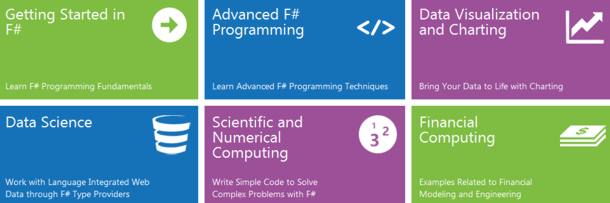
Microsoft has updated its Try F# web portal for developers with additional domain-specific tutorials for those wanting to learn the fundamentals of F#. The Try F# website which is designed to show off the F# programming language has graduated from being in beta and now comes with a set of six tutorials:
(click to enlarge) Announcing the update, the Microsoft Research Connections Blog explains: F# has become an invaluable tool in accessing, integrating, visualizing, and sharing data analytics. Try F# thus has the potential to become the web-based data console for bringing “big and broad data,” including the associated metadata, from thousands of sources (eventually millions) to the fingertips of developers and data scientists. Try F# helps fill the need for robust tools and applications to browse, query, and analyze open and linked data. It promotes the use of open data to stimulate innovation and enable new forms of collaboration and knowledge creation.
The blog post includes this video introducing the use of F# in education and research and it concludes: With Try F#, a researcher can quickly and easily access thousands of schematized and strongly-typed datasets. This presents huge opportunities in today’s data-driven world, and we strongly encourage all developers and data scientists to use Try F# to seamlessly discover, access, analyze, and visualize big and broad data. One hindrance to using the website "quickly and easily" is that it requires you to download the latest version of Silverlight which seems shortsighted for a website that has only recently moved from preview status. However don't let that put you off from trying these tutorials. It is interesting how slow some parts of Microsoft are to follow the company's lead on what is hot and what is not. For the moment F# still seems to be hot.
More InformationTry F#—Data Console to Big and Broad Data Related Articles
To be informed about new articles on I Programmer, install the I Programmer Toolbar, subscribe to the RSS feed, follow us on, Twitter, Facebook, Google+ or Linkedin, or sign up for our weekly newsletter.
Comments
or email your comment to: comments@i-programmer.info

|
| Last Updated ( Wednesday, 30 January 2013 ) |