| Intel Announces New Dev Suites |
| Written by Kay Ewbank | |||
| Thursday, 06 September 2012 | |||
|
Intel has shown off two new versions of its development suites for developers wanting to build shared memory and distributed applications.
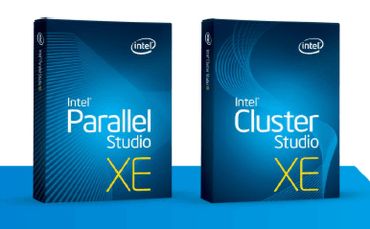
Intel Parallel Studio XE 2012 has been released today, and is aimed at developers who want to build shared memory applications. It includes Intel C++ and Fortran compilers, and threading, math, multimedia and signal processing performance libraries. The software comes with extensions that provide parallelism models that you can simply use in your applications. One extension, Intel Cilk Plus, is designed to improve the performance of programs on multicore and manycore processors. You use it simply by including three keywords in your app, and there are runtime and template libraries that show how to put together a well-tuned environment for building parallel applications. Intel Threading Building Blocks is a C++ template library for creating high performance, scalable parallel applications. The library contains components that implement higher-level, task-based parallelism. Parallel Studio XE also includes a threading assistant for Linux and Windows. Intel Advisor XE can be used with C, C++, C# and Fortran. It finds the regions of your apps with the greatest performance potential from parallelism, shows the estimated speed-up, and identifies critical synchronization issues. The other package, Intel Cluster Studio XE 2013, provides support for distributed and hybrid applications and will ship before the end of the year. Both packages can be used to write apps to run on Intel Ivy Bridge Core processors or on Intel Xeon Phi many-core co-processors. There’s a trial version of the new version of Parallel Studio XE available for download from the Intel Software Evaluation Center. The full version costs $2,299. More InformationIntel Parallel Studio XE 2013 for Windows - Evaluation Related Articles
Comments
or email your comment to: comments@i-programmer.info
To be informed about new articles on I Programmer, install the I Programmer Toolbar, subscribe to the RSS feed, follow us on, Twitter, Facebook, Google+ or Linkedin, or sign up for our weekly newsletter.

|
|||
| Last Updated ( Thursday, 06 September 2012 ) |