| The Mod Function |
| Written by Mike James | ||||
| Friday, 04 December 2020 | ||||
Page 1 of 3 What has modular arithmetic got to do with the real world? Many programmers are puzzled by the mod, short for modulo, and integer division functions/operators found in nearly all languages. Modular arithmetic used to be something that every programmer encountered because it is part of the hardware of every machine. You find it in the way numbers are represented in binary and in machine code or assembly language instructions. Once you get away from the representation of numbers as bit strings and arithmetic via registers then many mod and remainder operations lose their immediate meaning so familiar to assembly language programmers. You may not meet the mod function or operator in the course of learning to program, but once you start to write real code you will certainly meet it. As soon as you start implementing even the simplest of algorithms the need to understand mod will occur. Passive and ActiveThe mod(x,y) function, or the mod operator x % y in Python, C# or JavaScript say, is very simple but you can think about it at least two different ways - corresponding, roughly speaking, to passive and active models of what is going on.
Whenever you have a problem that involves chopping something up into regular sized groups the mod function/operator comes in handy for working out how to deal with the leftovers. it tells you the remainder after you have grouped x things into groups of size y.
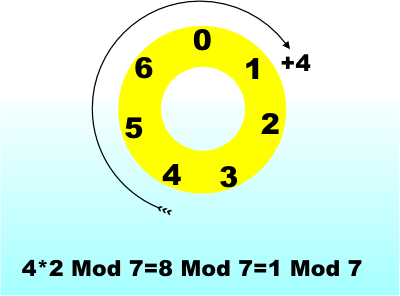
This definition is a bit more difficult to follow but it's still trivial as long as you studied `clock arithmetic' as part of modern maths at school. If you didn't then it's not too late. Clock arithmeticImagine a clock face with numbers from 0 to y-1 then counting mod y is simply a process of advancing from number to number until you reach y-1 when you `roll over' to 0 and start the sequence again. So counting mod 6 goes 0,1,2,3,4,5, 0,1,2,.. and so on. Notice that in counting mod 6 the integer 6 doesn't actually occur. Similarly arithmetic mod y works by moving the clock's hand on or back by the required amount. For example, 4+3 = 1 and 2-5 = 3 in arithmetic mod 6. That is on a clock face numbered 0 to 5 start at 4 and move the hand on by 3 and it points to 1. Similarly starting at 2 and moving 5 back gets the hand to 3. Multiplication and division work in exactly the same way once you remember that multiplication is repeated addition and division repeated subtraction. However it is generally easier to do the arithmetic ignoring the "clock face" and then finding the representation of the result on the clock face. For example, 5*8 is 60 and if you start with the clock hand on 0 and move it sixty places on you end up at 4. In programming all you have to do is to work out the arithmetic in the usual way e.g. 5*8=40 and then use the mod function to find its representation on the clock face -
For another example consider arithmetic mod 7 then 4*2 in mod 7 is:
You can see that this image of a clock face and a pointer advancing is appropriate for all sorts of simulations of real world objects. For example, a set of dials recording values in mixed units to different bases can be represented by counting in different mod bases. Counting in yards, feet and inches (with 3 feet in a yard and 12 inches in a foot) you would use something like
Integer DivisionNow we come to an interesting question; how to tell when a mod counter has rolled over. Adding one to the counter each time is a bit too easy because you can simply test for the counter being at zero after an update. A more interesting problem is how to check for roll over when an arbitrary value is added. For example, how do you discover how much to increment feet following
The answer needs integer division which is mod's other half. This is obvious if you think about Mod in its first interpretation as the remainder function. If you use Mod to divide up x things into groups of y then the remainder is what the clock dial shows. The number of groups of y that you formed is the number of times the clock "rolled over". You can find this out by working out the integer division of x by y i.e. how many whole times does y divide x - and this is integer division. Mod finds the remainder on the clock and integer division find the `how many times the clock rolled over'. Many languages do integer division naturally if you divide one integer type by another and there is no need for anything special. But in dynamically typed languages dividing one integer by another automatically gives a floating point number and to convert back to integer you have to use a function something like int, trunc or floor depending on the language. |
||||
| Last Updated ( Friday, 04 December 2020 ) |