| From Baby to Mark I |
| Written by Historian | |||
Page 1 of 2 The Manchester Baby, known formally as the Manchester Small Scale Experimental Machine, was one of the first stored program computers. It used a CRT tube to store data and worked sequentially a bit at a time. It took about an hour to find a factor of a number, but it was revolutionary. Today is the 70th anniversary of its first successful run of a program on June 21st 1948.
There was a time when there were no computers - and then there was a time when there were. You might be tempted to conclude from this that there was a “first” computer but the more I look into the history of the early days the more I become convinced that there wasn’t. The reason is that once the idea of a stored computer was in the air lots of different people caught its scent. Even a tiny whiff was enough for them to re-invent all they needed to build a computer. How clear this vision was varied greatly from one group to another - but in all cases it was enough for them to build a working machine. You can get into arguments about whose machine was switched on first or even which machine was a real computer - but this just hides the deeper truth. Manchester was one of the three main UK centres of computer development in the early days - the others were Cambridge and the National Physical Laboratory (NPL) at Teddington. Even though Cambridge built the first full size working stored computer, Manchester got a small machine - the “Baby" or Small Scale Experimental Machine - going first and so can claim the title of “first working stored program computer”. But this isn’t the Manchester School’s only important claim to fame - they built computers in the plural and it was Baby that took the initial steps. Computer Creators at ManchesterThe two key people in the story of the Manchester computers are Freddie Williams and Tom Kilburn but there were many other important influences and contributors, notably Alan Turing.
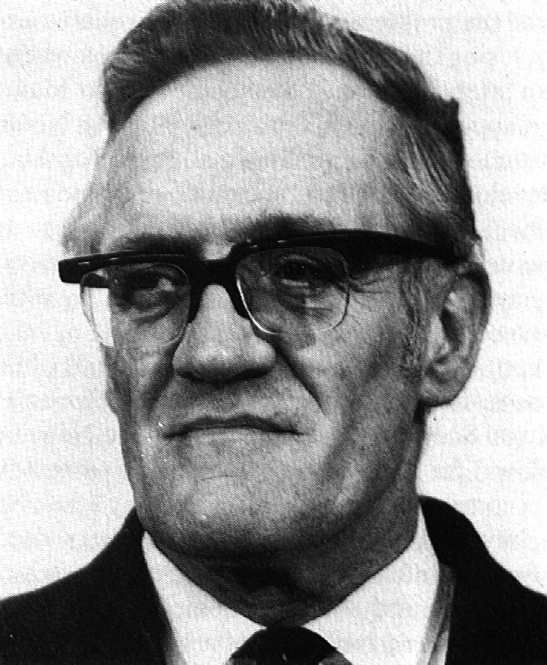
Frederic Calland Williams (1911-1977)
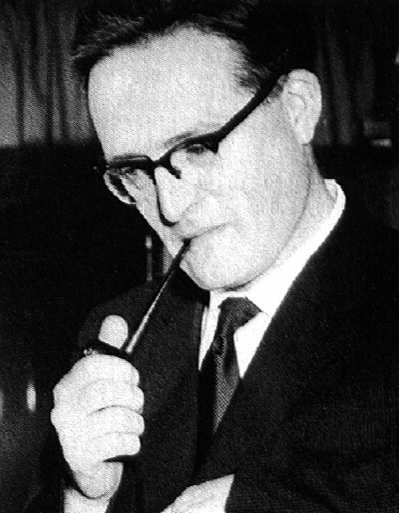
Tom Kilburn (1921-2001)
Williams was an engineer and very keen on the new science of electronics. He gave the first course at Manchester, where he was an assistant lecturer, on “electro-technics”. Even in these pre-electronic days computing had started to put down roots at Manchester. Hartree’s mechanical differential analyser was already built and in use and Williams was at work designing a “curve follower” for it. This expertise in analog computation and electronics made it natural for Williams to work on radar for the TRE (Telecommunications Research Establishment) when the war started. Kilburn first met Williams at the TRE facility in Malvern. He was a mathematician but his first war time assignment was to help Williams, then a Senior Scientific Officer, to develop electronics for radar use. He managed to learn practical electronics reasonably fast and soon came to be regarded as “useful”. The Williams Tube - the first DRAMTowards the end of the war Williams became editor of a 24-volume work on electronics - the importance of which was that it was published by MIT. This gave him the opportunity to visit the USA in 1945-46 and while there he heard of the work going on at the Moore school, where ENIAC was under construction. He also visited Bell labs where they were working on the problem of removing ground echoes from radar traces. Williams thought of using two CRTs to store the outline by passing it backwards and forwards between the two.
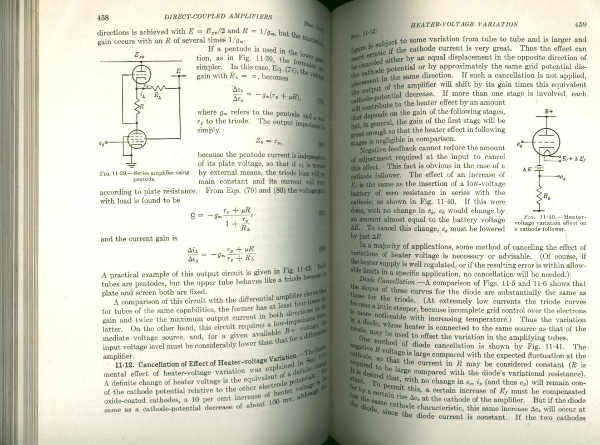
A page from Volume 18 of the MIT Radation Laboratory Series from http://www.oldcomputerbooks.com On his return to TRE, Willaims started work on building a demonstration system but then he realised that he could use the same technique to build a single tube digital storage system. By December he had a digital system based on a single CRT that could store 1 bit! It worked by leaving a gap in the trace or no gap in the trace. When the beam scanned the line a second time there was a pulse just before the edge marking where the gap was last time and this could be amplified and fed back to put the gap back in again. Of course if the gap wasn’t there last time there was no pulse and the trace was continuous. It was a classic two-state system ideal for storing digital data. The data is stored in the tube by creating a small charged area around where the electron beam hit the tube. Normally the tube had a phosphor coating which made the pattern visible but later tubes did away with the phosphor. A pickup electrode in the form of a mesh is placed over the face of the tube and this can pick up the tiny current when the charge is readout by passing the beam over the same spot. Unfortunately this wipes out the charge and it has to be refreshed to maintain the storage. Also the charge leaked away over time making it necessary to refresh the screen by reading every bit and writing it back to the same location. When the news of the success in storing a single bit reached people at the NPL, they decided that they wanted Williams to build a storage device for their computer project - the ACE. But Williams realised that the ACE, Alan Turing’s design for a computer, relied far too much on delay line storage to be easily converted to CRT storage so he returned to Manchester to develop his idea further. The Manchester TeamAlso newly returned to Manchester were Max Newman, I.J. Good and D. Rees - all fresh from the Bletchley Park code-breaking operation and with experience of the Colossus machine. Newman wanted to set up a computing facility for mathematics and, without knowing about the work on the ENIAC or the proposal to build the ACE, he wrote to Von Neumann at Princeton in order to find out how to build the computer he needed. He then applied to the Royal Society for a grant to build it. The committee formed to consider the application contained one dissenting member who was firmly of the opinion that a second computer project wasn’t worth funding - the NPL ACE would be enough computing power for everyone! Fortunately the grant was awarded - £20,000 over five years plus £3,000 per annum for salaries. Newman used it to create the Royal Society Computing Machine Laboratory. After spending some time with Von Neumann at the end of 1946, Newman realised that the real difficulty was developing a reliable storage system - one solution was to be found under his nose. Small-Scale Experimental MachineTom Kilburn joined Williams at Manchester at the start of 1947 and by the end of the year the two of them had a working system that could store 2048 bits. At this point Newman explained to Williams what sort of machine needed to be put with the memory he had created. They started work at once on a small machine - more or less built around the CRT store. This was called the Small-Scale Experimental Machine (SSEM) but was better known as "Baby“.
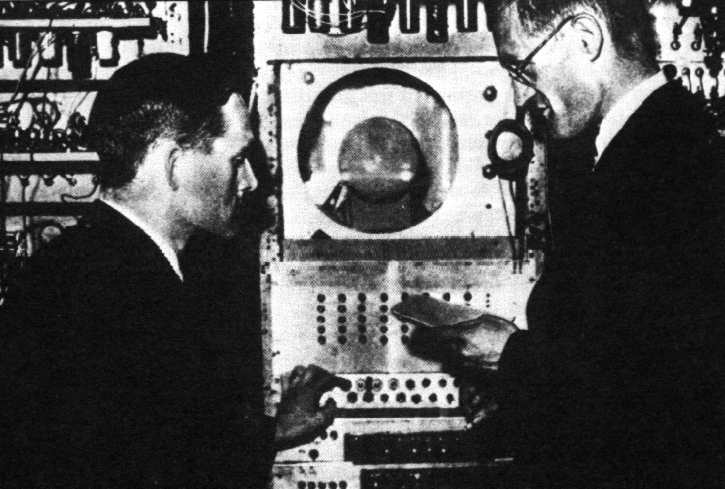
Kilburn and Williams with Baby The Manchester Baby was a serial computer - that is it worked one bit at a time. When you want to add two eight-bit numbers a serial computer does it by adding the first pair of bits, then the next pair and so on. A serial computer is relatively easy to build but it isn’t the natural way to use the inherently parallel storage provided by the CRT store. The Baby used 32 words of 32-bit storage and used CRT storage for its accumulator and its control registers. The only input device was a bank of switches and for output you had to read the dots on the front of the CRT tube as binary - there’s direct machine interaction for you! On June 21, 1948 the first program to run on any stored program computer found the highest factor of an integer. It took 52 minutes and Manchester folklore has it that it was the only program Kilburn ever wrote - the first and his last!
<ASIN:0262681374> <ASIN:0262517671> <ASIN:0813345901> <ASIN:0262532034> |
|||
| Last Updated ( Thursday, 21 October 2021 ) |