| New Powerful Arduino Due |
| Written by Harry Fairhead | |||||||||||||||||||||||||||||||
| Sunday, 21 October 2012 | |||||||||||||||||||||||||||||||
|
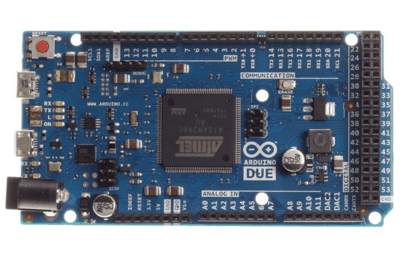
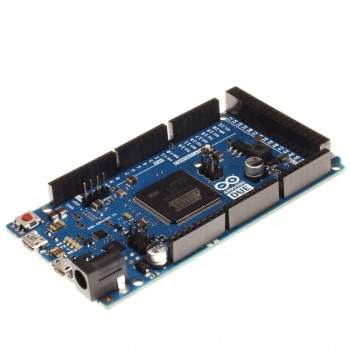
After six years in the making, the Arduino Due is finally becoming available and, with a price tag of $49, is bound to give a boost to the platform. The Arduino micro-controller is a perfect platform for rapid prototyping and has transformed physical computing, making it much more accessible for electronics enthusiasts. The Due, which means 2 in Italian and is pronounced "doo-eh", replaces the 8-bit, 16MHz Uno by a 32-bit, 84MHz processor board that also has a range of new features. Like the Arduino Leonardo, released this summer, it has two micro USB ports, one for programming and communications and one that allows the Due to act as a client or host, allowing it to act as or utilize a USB mouse or keyboard.
The heart of the new Arduino Due is the Atmel SAM3X8E, an ARM Cortex-M3-based processor, which gives it a huge boost in ADC performance, opening up possibilities for designers. The theoretical sampling rate has gone from the 15 ksps (kilosamples per second) of the existing boards, the Arduino Uno, Leonardo, and Mega 2560, to a whopping 1,000 ksps. The Arduino's creator, Massimo Banzi, told Wired: “Many people have built cool open source scientific instruments using Arduino in the past, with the Due they get 12-bit analog inputs, 12-bit analog outputs.” The Due is also the first Arduino to feature a built-in digital-to-analog converter, in fact two of them. It is also to have an audio library to take advantage of its ability to playback wav files. The Arduino capabilities have always been extended by shields, add-on boards and circuitry such as motion sensors and LED light arrays, many of them for third-party manufacturers. The Due will work with all Arduino shields that conform to the official Arduino Revision 3 layout. However, the Due operates at 3.3V whereas earlier Arduinos operate at 5V, so some third-party shields that don’t follow the R3 specs to the letter may not be compatible, depending on their voltages. This also suggests that anyone using the Due in existing applications should pay particular attention to voltage.
It has the following technical specification:
Despite its increase in power and features, Banzi suggests that beginners and less advanced users should probably stick with the classic Uno for now: “The basic Arduinos like the UNO or Leonardo are still the best to learn with. They are super simple, very stable and come with tons of examples and libraries.” More InformationWired - Arduino Finally Releases the 32-Bit Due Related ArticlesArduino Goes Official - Release of 1.0
Comments
or email your comment to: comments@i-programmer.info
To be informed about new articles on I Programmer, install the I Programmer Toolbar, subscribe to the RSS feed, follow us on, Twitter, Facebook, Google+ or Linkedin, or sign up for our weekly newsletter.

|
|||||||||||||||||||||||||||||||
| Last Updated ( Monday, 22 October 2012 ) |