| SmoothLife - A Continuous Conway's Life |
| Written by Mike James | |||
| Saturday, 13 October 2012 | |||
|
Conway's Game of Life is well known, but what about a version that works not on a discrete grid but in the continuum? It has all of the features of Life, including gliders, and it really looks alive. A paper published at the end of last year by Stephan Rafler described a generalization of Life to a continuous domain. He called it SmoothLife. If you recall, Life is an example of a 2D cellular automata and works on a grid of "cells" that obey two simple rules:
(If you want to see Life in action we have a Silverlight version available) You can regard many cellular automata as discrete approximations to particular differential equations. The best known perhaps is the repeated replacing of a center cell by the average of its neighbors as a way of solving the Laplace equation.
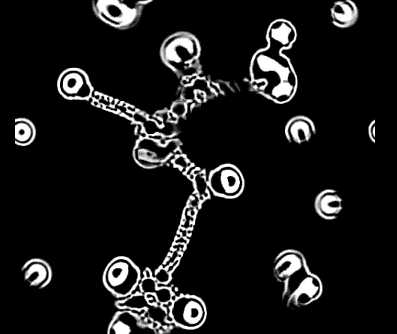
What has happened in this case is that the process has been reversed and the discrete approximation has been taken back to the continuous differential equation. Now the cell becomes a circular disk and the nearest neighbors form a ring around it. The rules now concern integrals taken over the relevant areas and the rules become a function which takes the integrals to new values of the cell. Now we have a new video by Tim Hutton of SmoothLifeL (a particular version of the rule) in action complete with gliders: "SmoothLife is a family of rules created by Stephan Rafler. It was designed as a continuous version of Conway's Game of Life - using floating point values instead of integers. This rule is SmoothLifeL which supports many interesting phenomena such as gliders that can travel in any direction, rotating pairs of gliders, wickstretchers and the appearance of elastic tension in the 'cords' that join the blobs." Take a look for yourself:
Given the way that the blobs move and behave, it is difficult not to see them as biological. Simple rules give rise to complex behavior. The animation was created using Ready - a reaction-diffusion simulator that makes use of OpenCL to speed things up. If you are interested in continuous CAs or reaction diffusion simulations this looks like a good place to start. UpdateIf you would like a JavaScript simulation of SmoothLife to play with try: http://jsfiddle.net/CSyUb/ More InformationGeneralization of Conway's "Game of Life" to a continuous domain - SmoothLife Related ArticlesCellular Automata - The How and Why A New Computational Universe - Fredkin's SALT CA A Computable Universe - Roger Penrose On Nature As Computation
Comments
or email your comment to: comments@i-programmer.info
To be informed about new articles on I Programmer, install the I Programmer Toolbar, subscribe to the RSS feed, follow us on, Twitter, Facebook, Google+ or Linkedin, or sign up for our weekly newsletter.

|
|||
| Last Updated ( Saturday, 13 October 2012 ) |