| ENIAC Replica Built In Cardboard By Teenagers |
| Written by Sue Gee | |||
| Sunday, 25 January 2026 | |||
|
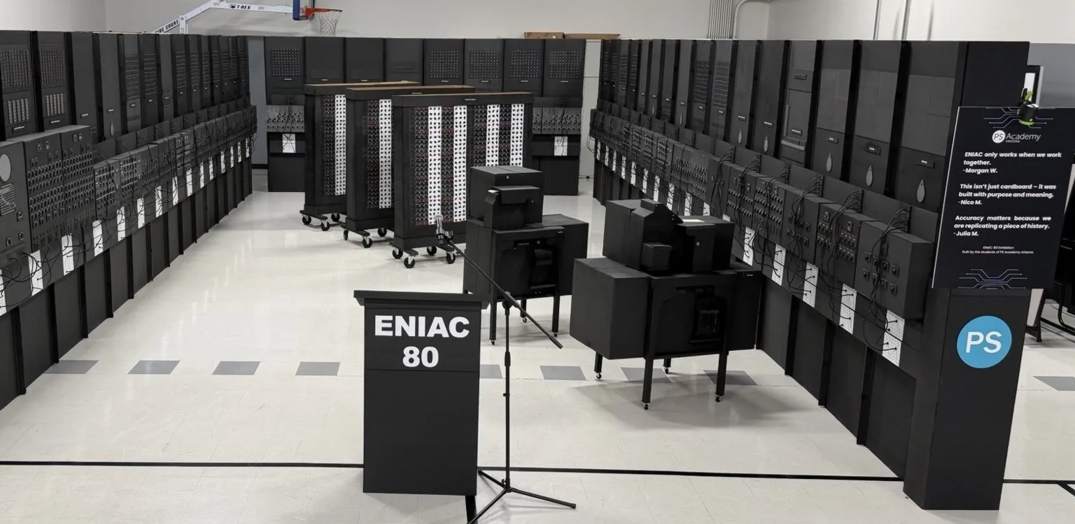
A full-scale replica of ENIAC, the world's first general-purpose computer, has been built to mark its 80th anniversary next month. Although not functional, the 500 square foot model visually simulates the original and is impressive in its sheer size and attention to detail.
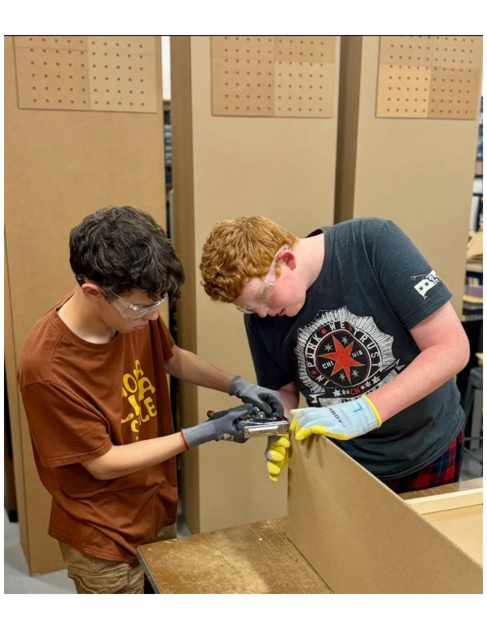
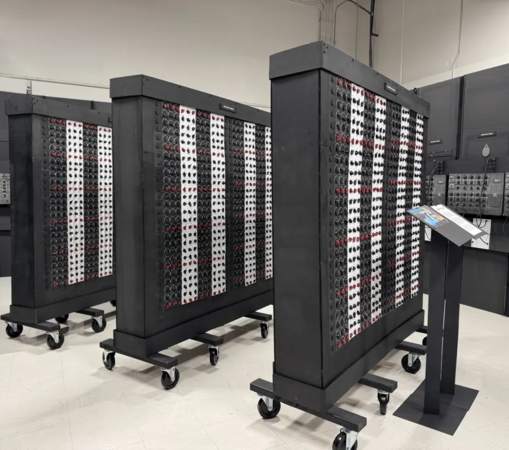
Photo Credit: Tom Burick ENIAC (Electronic Numerical Integrator and Computer) was the first general-purpose, programmable electronic computer. Conceived by John Mauchley and Presper Eckert during the Second World War, construction began in 1944 and finished in 1945. Weighing 30 short tons (about 27 metric tons), it was formally accepted in 1946 by the US Army Ordnance Corps, which had financed it. Eight decades later, a group of 80 autistic teenagers, students at PS Academy, Arizona, has recreated the ENIAC using wood and cardboard. The project, which took nearly six months to complete, involved building 22,000 custom parts and assembling them with 1,600 hot glue gun sticks into 45 individual units. As with most other computers of the era, the original ENIAC is long gone, dismantled as obsolete and its components distributed to museums and universities. Whereas the replica of Colossus, its near contemporary in time although on the other side of the Atlantic, was reconstructed to be fully functioning with as many original components as possible, the intention in this case was different. The academy's Technology Instructor Tom Burick explained: "This project was never intended to recreate a working ENIAC. It was designed to recreate the experience, scale, and structure of ENIAC – so students and the public can understand what early computing really looked like and what it demanded of the people who built and operated it." Instead of large steel panels full of wiring and electronics, the 1:1 panels are made from layered cardboard and wood, with a smattering of LED lighting. However, as Burick points out: "Every major unit, accumulators, function tables, initiator, master programmer, is present and placed exactly where it was on the original machine." To ensure historical accuracy, the students, under the direction of first had to really understand how the machine worked. They corresponded with Brian Stuart, an ENIAC historian, reached out to the descendants of ENIAC co-creator John Mauchly, and worked with Dag Spicer, senior curator of the Computer History Museum. According to Burick, the students had "astounding access to original patent drawings, Army documentation, and detailed photographs". Photo Credit: Tom Burick
Further Information:How 80 Autistic Students Built an Amazing Replica of the Ginormous ENIAC Computer Related articles:On This Day in 1946 - Eniac Unveiled 
|
|||
| Last Updated ( Sunday, 25 January 2026 ) |