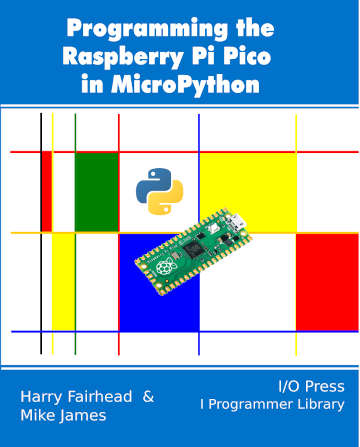
| Programming The Raspberry Pi Pico In MicroPython (I/O Press) |
| Wednesday, 19 May 2021 | |||
|
The Raspberry Pi Pico is a remarkable microcontroller. It has a power and sophistication that would have been unthinkable just a short time ago. For the sort of jobs it is ideal for, it has plenty of processing power and enough memory to make tasks that would have once required careful planning, relatively easy. Instead of struggling with the machine, you can now focus on getting a good implementation of your algorithms.MicroPython is a good choice of language to program the Pico. It isn’t the fastest way, but in most cases it is fast enough to interface with the Pico’s hardware and its big advantage is that it is easy to use. <ASIN:1871962692> Authors: Harry Fairhead & Mike James
The purpose of this book is to reveal what you can do with the Pico's GPIO lines together with widely used sensors, servos and motors and ADCs. After covering the GPIO, outputs and inputs, events and interrupts, it gives you hands-on experience of PWM (Pulse Width Modulation), the SPI bus, the I2C bus and the 1-Wire bus. One of the key advantages of the Pico is its PIO (Programmable I/O) and while this is an advanced feature it is included in this book. After finding out how the PIO works, we apply it to writing a PIO program for the DHT22 and the 1-Wire bus. One current drawback of the Pico it is that it doesn’t have a network connection. To solve this problem there is a chapter on using the low-cost ESP8266 as a WiFi client and web server. The two devices together make the Pico a true IoT device. If speed is a key concern see the companion volume, Programming The Raspberry Pi Pico In C.
For more Book Watch just click. Book Watch is I Programmer's listing of new books and is compiled using publishers' publicity material. It is not to be read as a review where we provide an independent assessment. Some, but by no means all, of the books in Book Watch are eventually reviewed. To have new titles included in Book Watch contact BookWatch@i-programmer.info Follow @bookwatchiprog on Twitter or subscribe to I Programmer's Books RSS feed for each day's new addition to Book Watch and for new reviews.

<ASIN:1871962684> <ASIN:B093LT5W54> |