The Minimum Spanning Tree - Prim's Algorithm In Python
Written by Mike James   
Thursday, 05 October 2023
Article Index
The Minimum Spanning Tree - Prim's Algorithm In Python
Prim's Algorithm In Python
Implementing Prim's algorithm
Listing

Listing

The complete listing is:

import tkinter
import random
import math
import random
size = 8
height = 550
width = 600
class Point:
    X = 0
    Y = 0
Pos = []
Network = []
def distance(a, b):
    return math.sqrt((a.X - b.X) ** 2 + (a.Y - b.Y) ** 2)
def showNetwork(canvas, Network):
    canvas.delete("all")
    for i in range(size):
        p1 = Pos[i]
        for j in range(i):
            if Network[i][j] > 1:
                p2 = Pos[j]
                canvas.create_line(p1.X, p1.Y,
p2.X, p2.Y)
    for i in range(size):
        p1 = Pos[i]
        canvas.create_rectangle(p1.X-5, p1.Y-5, p1.X+5,
                                p1.Y+5, outline="black",
fill="red", width=2)
def setnet(canvas):
    global Network
    global Pos
    Pos = [0 for j in range(size)]
    Network = [[0 for j in range(size)]
for i in range(size)]
    maxlength = math.floor(
        min(canvas.winfo_width(),
canvas.winfo_height()) * 0.9)
    minlength = math.floor(maxlength / size)
    for i in range(size):
        p = Point()
        p.X = random.randint(minlength, maxlength)
        p.Y = random.randint(minlength, maxlength)
        Pos[i] = p
        for j in range(i+1):
            Network[i][j] = distance(Pos[i], Pos[j])
            Network[j][i] = Network[i][j]
    showNetwork(canvas, Network)
def closest(n, included, excluded):
    smallest = -1
    for i in range(n):
        for j in range(size):
            if excluded[j] == -1:
                continue
            if smallest == -1:
                smallest = Network[included[i]]
[excluded[j]]
            if Network[included[i]][excluded[j]] >
smallest:
                continue
            smallest = Network[included[i]][excluded[j]]
          start = i
            finish = j
    return start, finish
def prims():
    finished = [[0 for j in range(size)]
for i in range(size)]
    included = [-1 for i in range(size)]
    excluded = [i for i in range(size)]
    included[0] = excluded[random.randint(0, size-1)]
    excluded[included[0]] = -1
    for n in range(1, size):
        start, finish = closest(n, included, excluded)
        included[n] = excluded[finish]
        excluded[finish] = -1
        finished[included[n]][included[start]] =
Network[included[n]][included[start]]
        finished[included[start]][included[n]] =
Network[included[start]][included[n]]
        showNetwork(C, finished)

top = tkinter.Tk()
C = tkinter.Canvas(top, bg="blue",
height=height, width=width)
button = tkinter.Button(top, text="Generate Network",
                        command=lambda: setnet(C))
button.place(x=10, y=height-40)
button = tkinter.Button(top, text="MST", command=prims)
button.place(x=200, y=height-40)
C.pack()
top.mainloop()

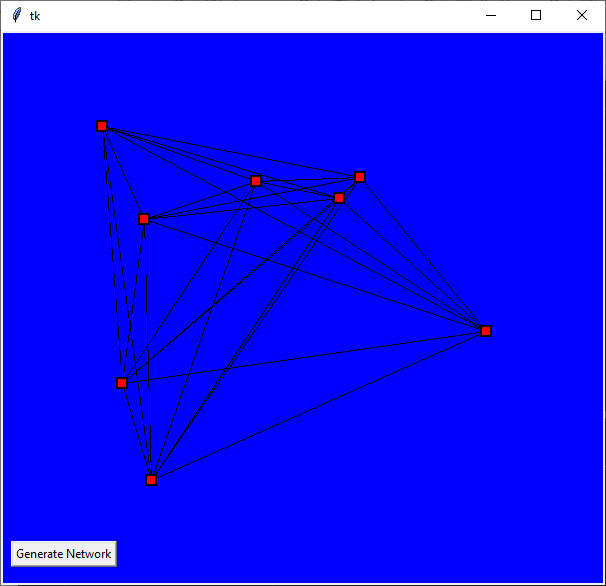
net1

Related Articles:

Shortest Path Breakthrough

The Minimum Spanning Tree In C# - Prim's or Dijkstra Algorithm

  •  Mike James is the author of the Programmer's Python: Something Completely Different series of books which set out to show how Python diverges from other programming languages and how its special features deserve our attention.


Disk Drive Dangers - SMART and WMI

Getting access from an application to the hardware is never easy. If you want to know how well your disk drive is performing then there is a way of accessing the SMART data - including the temper [ ... ]


The Minimum Spanning Tree In C# - Prim's or Dijkstra Algorithm

Finding the minimum spanning tree is one of the fundamental algorithms and it is important in computer science and practical programming. We take a look at the theory and the practice. 


Other Projects


Python In The Age Of AI
30/11/2025

For its Octoverse event, GitHub recorded an interview with Guido van Rossum, the creator of Python. From it we learn about the origins of Python and its name and its role in the age of AI.


Build AI Apps with MCP Servers With DeepLearning.AI
28/11/2025

A new course, thanks to Andrew Ng and his partnership with Box, that shows how you can leverage MCP servers to offload otherwise laborious and custom-made work.


More News

pico book


Comments


or email your comment to: comments@i-programmer.info

<ASIN:1584885491>

<ASIN:1871962765>

<ASIN:1871962749>

<ASIN:1871962757>


Last Updated ( Sunday, 06 October 2024 )