| SPARQL Moves Closer |
| Written by Kay Ewbank | |||
| Thursday, 15 November 2012 | |||
|
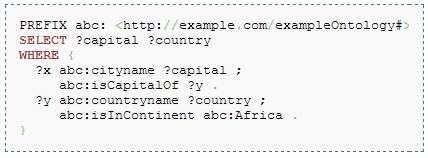
The W3C SPARQL Working Group has published documents that move SPARQL 1.1 to the status of Proposed Recommendation, signaling that it is now time to implement this specification. SPARQL, an acronym for SPARQL Protocol And RDF Query Language is a system for working with Resource Description Framework data. It comprises a query/update language, two HTTP protocols (one full-featured, one using basic HTTP verbs), three result formats, and other features which allow SPARQL endpoints to be combined and work together. Using SPARQL you can work with data stored in Resource Description Framework format, and many industry bigwigs (including Tim Berners-Lee) say it will become one of the key technologies of the semantic web. The syntax of SPARQL is SQL-like, and you use it to work with RDF graphs by making use of pattern matching. The advantages SPARQL offers over a combination of SQL and XQuery start with its implicit join syntax. When you query an RDF graph, the graph contains subgraphs with some elements replaced by variables. The relationships are of a fixed size and all the data is in the single graph, so SPARQL doesn’t need to have explicit joins to define the relationship between differently structured data. It also has strong support for querying data with an unpredictable and unreliable structure. This example is from Wikipedia models the question "What are all the country capitals in Africa?". Variables are indicated by a "?" or "$" prefix. Bindings for ?capital and ?country will be returned:
Another advantage of SPARQL is its notion of an RDF dataset, which is the pairing of a default graph and zero or more named graphs. The default graph and the named graphs are both identified by URIs, so you can retrieve a graph by performing an HTTP GET on the graph's URI. This allows a single query to join information from multiple data sources accessible across different Web sites. W3C members are being asked to review the SPARQL 1.1 Proposed Recommendation before December 6, 2012 in order to allow W3C to determine whether to issue this document as a W3C Recommendation.
More InformationSPARQL 1.1 Proposed RecommendationRelated ArticlesNew Open Source Semantic Engine Foundations of Semantic Web Technologies (Book Review)
Comments
or email your comment to: comments@i-programmer.info
To be informed about new articles on I Programmer, install the I Programmer Toolbar, subscribe to the RSS feed, follow us on, Twitter, Facebook, Google+ or Linkedin, or sign up for our weekly newsletter.

|
|||
| Last Updated ( Thursday, 15 November 2012 ) |