| Photos Of Ada Lovelace Saved For UK |
| Written by Sue Gee | |||
| Sunday, 28 December 2025 | |||
|
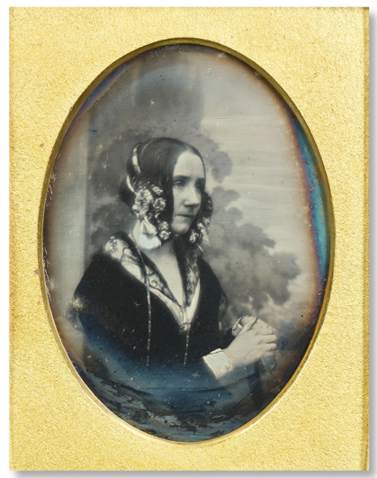
The only known photographs of Ada Lovelace, which were withdrawn from an online auction in June, have been acquired by the UK National Portrait Gallery. Ada Lovelace is known both as the estranged daughter of poet Lord Byron and as the First Computer Programmer I Programmer's articles about her are illustrated by two striking portraits - a full length oil on canvas of her aged 20 painted in 1836 by Margaret Sarah Carpenter, in which she is dressed in a formal white gown standing in a grand interior, and a three-quarter-length portrait around four years later by Swiss painter, Alfred Edward Chalon in which she appears wearing a mantilla (a lace veil) and holding a fan. However, by this time the first daguerreotypes had begun to appear and, given Ada Lovelace's interest in science and technology, it comes as no surprise to discover that one of the earliest proponents made two portraits of her. Antoine Claudet (1797-1867) learned photography from Louis Daguerre in the late 1830s, before establishing his first daguerreotype studio in London in 1841. His sitters included Sir Charles Wheatstone, Michael Faraday and Charles Babbage and it is likely that one of them recommended him to their friend Lovelace.
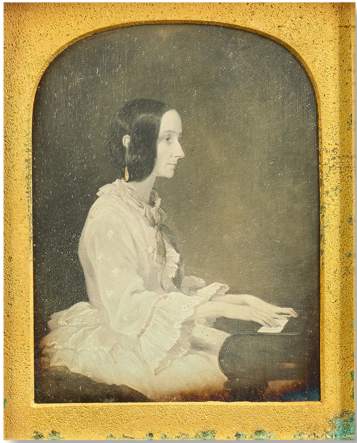
The two Claudet portraits of Lovelace, together with a third daguerreotype were part of a lot up for sale by Bonhams in London in June 2025 with an estimate of £80,000 to £120,000 but were withdrawn just before the auction. It has now been confirmed that the National Portrait Gallery bought them privately. The acquisition was supported by Tim Lindholm and Lucy Gaylord Lindholm through the American Friends of the National Portrait Gallery. According to Bonhams: [The daguerreotypes by Claudet] were taken around the critical year 1843 when Lovelace published her celebrated paper on Babbage’s Analytical Engine. In it she described in table form the use of punched cards to calculate Bernoulli numbers – often dubbed ‘the first computer programme’. Her comment that ‘The Analytical Engine has no pretension whatever to originate anything,’ has also been said to anticipate debates on artificial intelligence. The catalog also explains that the third daguerreotype is by an unknown photographer and reproduces a painting by Henry Wyndham Phillips (1820-1868) Lovelace sat for Henry Phillips in August 1852, and in the intervening decade since the Claudet photographs, her already fragile health had worsened. She was suffering horrifically from the uterine cancer that would end her life that November. Seated at a piano, she is gaunt and in a laudanum-induced daze – her husband William remarking in his diary that “the suffering was so great that she could scarce avoid crying out”, yet “she sat at the piano some little time so that the artist could portray her hands”.
The catalog also notes: Lovelace was particularly intrigued by photography, however, and wrote presciently in an unpublished piece that "it is as yet quite unsuspected how important a part photography is to play in the advancement of human knowledge." To know more about Ada Lovelace and her association with Charles Babbage and his Analytical Engine read Ada Lovelace: The First Programmer, I Programmer's account of her remarkable history. More InformationOnly known photographs of Ada Lovelace Related ArticlesAda Lovelace, The First Programmer Ada Lovelace: Countess Of Computing To be informed about new articles on I Programmer, sign up for our weekly newsletter, subscribe to the RSS feed and follow us on Facebook or Linkedin. 
Comments
or email your comment to: comments@i-programmer.info |
|||
| Last Updated ( Sunday, 28 December 2025 ) |