| ChartDB - The ERD Agent |
| Written by Nikos Vaggalis | |||
| Thursday, 16 October 2025 | |||
|
ChartDB strikes back with a database agent that auto-magically draws database schemas for you. Last February in Database Diagramming With ChartDB we looked at ChartDB as an open-source database diagrams editor that can be self-hosted or used in the Cloud which could:
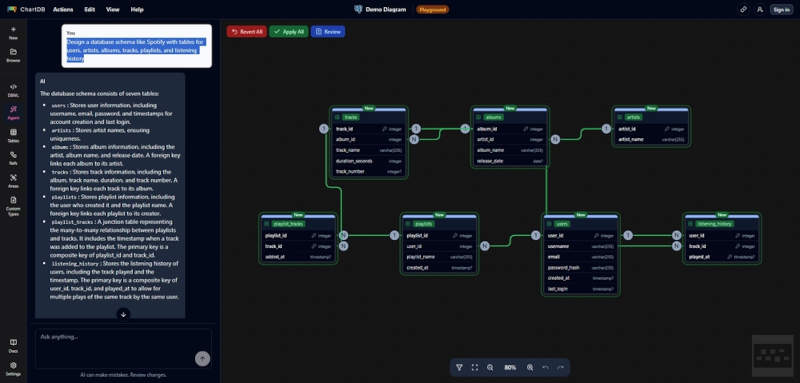
This time it's going beyond manually drawing ERDs ands lets you create schemas using natural language just by describing what you need. In essence it enriched the standard UI with another option, that of the Agent. Clicking on the Agent icon and choosing one of the default templates, such as "Design a database like Spotify", gets expanded to the prompt: Design a database schema like Spotify with tables for users, artists, albums, tracks, playlists, and listening history and voilà there is your schema appearing:
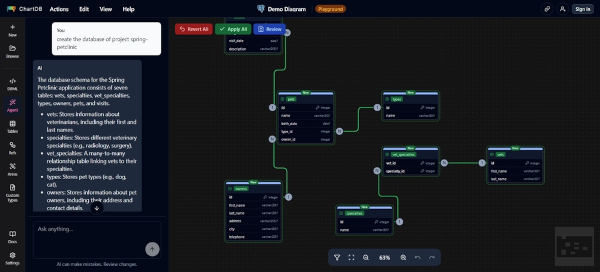
You also get a nice description with it : The database schema consists of seven tables: I went a step beyond in trying to reverse engineer a popular Spring project up on GitHub: Prompt: Create the database of project spring-petclinic
Thus this means that you can get the underlying database schema of any application that is backed by a database and exposes its source. Of course you can also make your own customized schemas by writing your manual prompts like Design an e-shop for selling video games As mentioned together with the diagram you get a high level description too, which in this case amongst others includes the following paragraph: Primary keys are defined for each table, and foreign key constraints are used to establish relationships between tables. SERIAL is used for auto-incrementing primary keys. DECIMAL is used for monetary values. TIMESTAMP WITH TIME ZONE is used for storing timestamps. CHECK constraint is used to ensure rating values are within the valid range. Finally you can export the DDL to import it into your database and get going from there. As mentioned, ChartDB comes in two flavors, cloud-based or self-hosted. To host it yourself you can build it from source by cloning the Github repo or grab the docker image for convenience.
More InformationRelated ArticlesDatabase Diagramming With ChartDB
To be informed about new articles on I Programmer, sign up for our weekly newsletter, subscribe to the RSS feed and follow us on Facebook or Linkedin. 
Comments
or email your comment to: comments@i-programmer.info |