| Meet World’s Smallest Programmable, Autonomous Robots |
| Written by Lucy Black | |||
| Friday, 02 January 2026 | |||
|
Researchers at the University of Pennsylvania and the University of Michigan have created what they say are the world's smallest fully programmable, autonomous robots: microscopic swimming machines that can independently sense and respond to their surroundings, operate for months and cost just a penny each. The robots are smaller than a grain of salt, and barely visible to the naked eye. Each robot measures about 200 by 300 by 50 micrometers. The robots are powered by light, carry microscopic computers and can be programmed to move in complex patterns, sense local temperatures and adjust their paths accordingly.
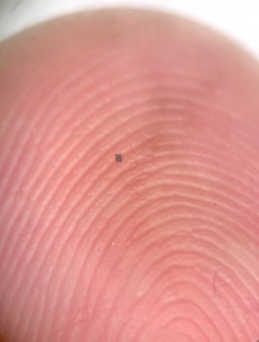
A microrobot, fully integrated with sensors and a computer, small enough to balance on the ridge of a fingerprint. (Credit: Marc Miskin, Penn) The research, which was described in Science Robotics and Proceedings of the National Academy of Sciences (PNAS), says the robots operate without tethers, magnetic fields or joystick-like control from the outside, making them the first truly autonomous, programmable robots at this scale. Marc Miskin, Assistant Professor in Electrical and Systems Engineering at Penn Engineering and the papers' senior author, comments: "We've made autonomous robots 10,000 times smaller. That opens up an entirely new scale for programmable robots." Miskin says that building robots that operate independently at sizes below one millimeter is incredibly difficult. When you're working at the size of a cell, the forces tied to surface area, like drag and viscosity, become important. "If you're small enough, pushing on water is like pushing through tar." Part of the problem lies in finding ways to move the tiny devices, because limbs at this scale are hard to build and easy to break. Instead, the team looked at different options. Fish move by pushing the water behind them, but the new robots don't flex their bodies; instead, they generate an electrical field that nudges ions in the surrounding solution. Those ions, in turn, push on nearby water molecules, animating the water around the robot's body. "It's as if the robot is in a moving river, but the robot is also causing the river to move." The robots can adjust the electrical field that causes the effect, allowing them to move in complex patterns and even travel in coordinated groups, much like a school of fish, at speeds of up to one body length per second. An advantage of this is that because the electrodes that generate the field have no moving parts, the robots are extremely durable, and with tiny solar panels charged by the glow of an LED, the robots can keep swimming for months on end. A team led by David Blaauw at the University of Michigan then added a complete onboard computer, meaning the robot can receive and follow instructions autonomously. Blaauw's lab holds the record for the world's smallest computer, and the two teams began working together after meeting at a presentation hosted by the Defense Advanced Research Projects Agency (DARPA) five years ago. The key challenge for the electronics, according to Blaauw, is that the solar panels are tiny and produce only 75 nanowatts of power: "That is over 100,000 times less power than what a smart watch consumes." To overcome this limitation, the Michigan team developed special circuits that operate at extremely low voltages and bring down the computer's power consumption by more than 1000 times.
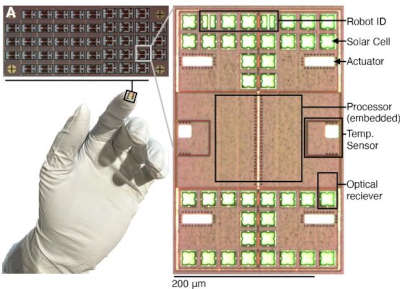
The robot has a complete onboard computer, which allows it to receive and follow instructions autonomously. (Miskin Lab and Blaauw Lab) The other main limitation is that of physical space. The solar panels occupy the majority of the space on the robot, so the processor and memory had to fit into what little space remained. The end result is the first sub-millimeter robot that can actually think. To the researchers' knowledge, no one has previously put a true computer - processor, memory and sensors - into a robot this small. The robots have electronic sensors that can detect the temperature to within a third of a degree Celsius. This lets robots move towards areas of increasing temperature, or report the temperature, allowing them to monitor the health of individual cells. The reporting of the temperature measurements is done via the wiggles of a little dance the robot performs. The team look at the dance through a microscope with a camera and decode from the wiggles what the robots are saying. Blaauw said: "It's very similar to how honey bees communicate with each other." The full report is available in Science Robotics. More InformationRelated ArticlesRobotic Gut Spider For Exploring Digestive Tract Swarm-Developing Cyborg Cockroaches World’s Smallest Wireless Flying Robot Takes Off To be informed about new articles on I Programmer, sign up for our weekly newsletter, subscribe to the RSS feed and follow us on Facebook or Linkedin. 
Comments
or email your comment to: comments@i-programmer.info |
|||
| Last Updated ( Friday, 02 January 2026 ) |